Analytical scope
What Materials Need To Be Tested For?
The phrase 'military-grade explosives' means nothing to a laboratory. A laboratory needs a schedule of named determinands with methods and detection limits. This page sets out what such a schedule would contain and why.
Facility imagery
Published description of on-site facilities
Operator-published material describing the underground excavations, vibration chamber, firing range and licensed explosive storage.
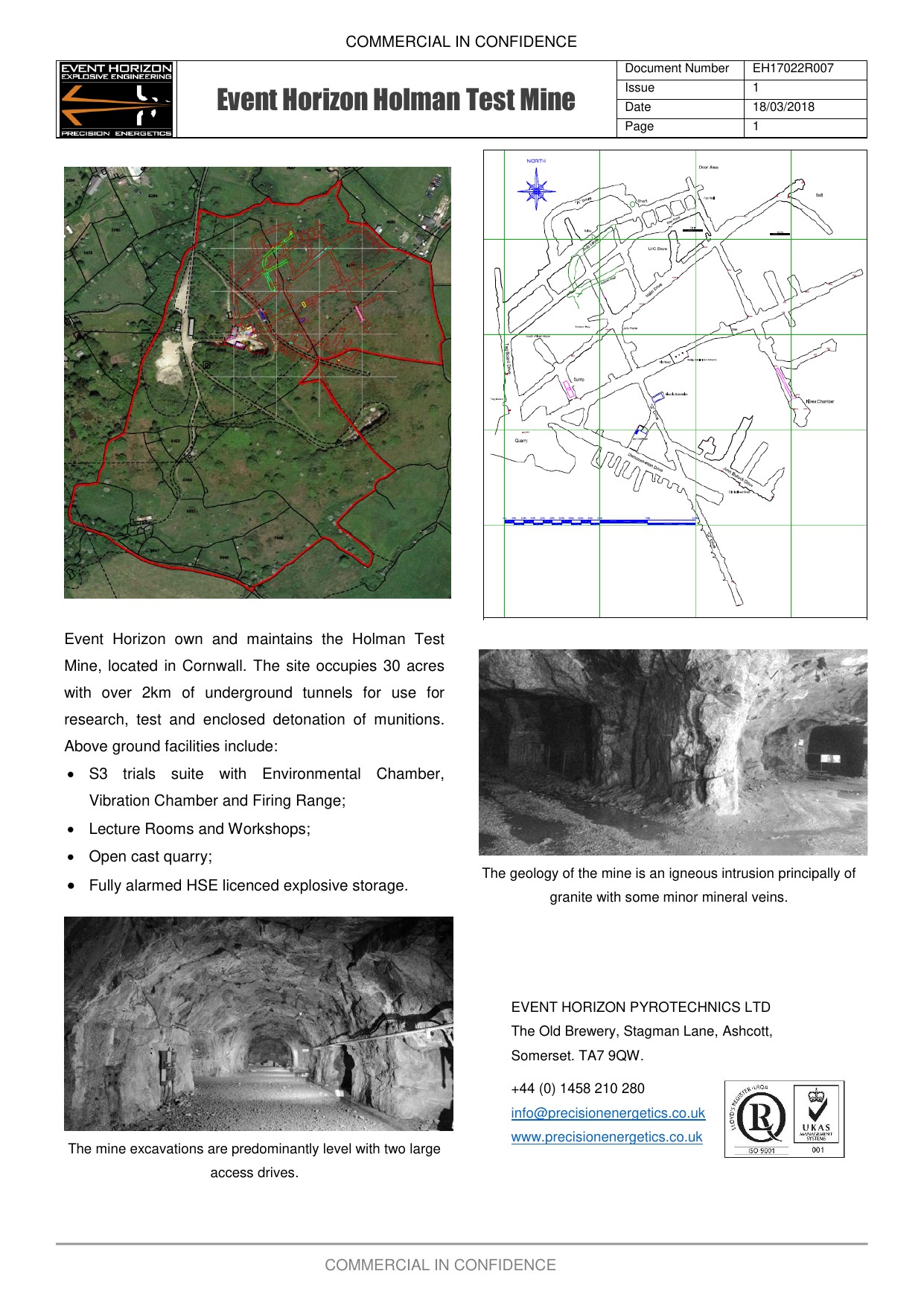
Operator facility description sheet
Operator facility sheet for Holmans Test Mine describing underground tunnels, a 3D trials suite, environmental chamber, vibration chamber and firing range, lecture rooms and workshops, an open-cast quarry and fully alarmed HSE-licensed explosive storage.
Source: Operator-published material reproduced in the master dossier
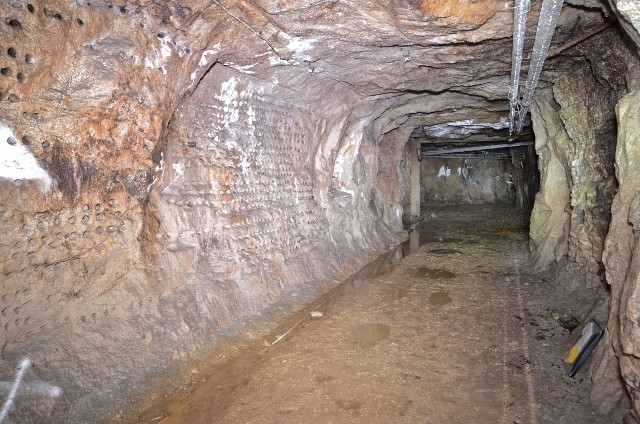
Underground tunnel, granite host rock
Photograph of an underground excavation in granite with a graded floor and a side chamber opening. The operator states excavations are predominantly in igneous intrusive granite with some minor mineral veins.
Source: Operator-published material reproduced in the master dossier
Candidate analytical suite
Determinands an environmental chemist would consider
Final scheduling is a professional judgement based on what the operational records show, the receptors present, and the detection limits achievable.
TNT
2,4,6-trinitrotoluene
A long-established military explosive. Environmentally persistent in some soils and detectable at low concentrations by standard methods.
RDX
cyclotrimethylenetrinitramine
A widely used high explosive. Relatively mobile in groundwater compared with TNT, which is why it features in groundwater investigations.
HMX
octogen
A high explosive frequently present alongside RDX as a manufacturing constituent or impurity.
PETN
pentaerythritol tetranitrate
A high explosive used in detonating cord and boosters.
DNT compounds
dinitrotoluene isomers
Manufacturing impurities and degradation products of TNT, often more mobile than the parent compound.
Nitroglycerine
glyceryl trinitrate
A constituent of propellants and some commercial explosives.
Perchlorate
ClO₄⁻
Associated with certain propellants and pyrotechnics. Highly mobile and persistent in groundwater where present.
Nitrate
NO₃⁻
A common degradation end-product of nitrogenous energetics — but also overwhelmingly an agricultural signal, so controls are essential.
Nitrite
NO₂⁻
An intermediate species indicating active nitrogen transformation.
Ammonium
NH₄⁺
Arises from agricultural, organic and, in specific circumstances, energetic-material sources.
Toxicology
Why this matters
Several recognised energetic compounds carry established toxicological concerns. These are properties of the substances themselves, documented in the international toxicological literature, and stating them is not a statement about this location.
- TNT has been classified by the US EPA as a possible human carcinogen.
- RDX has also historically been classified by the US EPA as a possible human carcinogen.
- TNT exposure has been associated with blood and liver effects.
- Contaminated drinking water is an important potential environmental exposure route for some energetic compounds.
The relevant question for Troon and Carwynnen is not merely whether hazardous compounds exist in military munitions. It is whether any such compounds or their degradation products are present in environmental media outside the operational site, and whether a physical pathway exists to receptors.
Two signatures
Legacy mine chemistry versus modern energetic markers
Distinguishing these is the analytical heart of the investigation, because this landscape guarantees the first and says nothing about the second.
Legacy mine chemistry
Expected across Cornwall's mining districts. Its presence is normal and proves nothing about modern activity.
- Iron
- Manganese
- Sulphate
- Acidity
- Arsenic
- Lead
- Copper
- Zinc
- Cadmium
Modern energetic signatures
Not expected from historic mining. Their presence would require a modern explanation.
- TNT
- RDX
- HMX
- PETN
- DNTs
- Perchlorate
- Energetic N-compounds
Finding both signatures together within a demonstrated pathway would be substantially more informative than finding ordinary historic mine metals alone. Legacy metals establish that a mine-water pathway is active; energetic markers, if present, would indicate that something more recent is travelling along it. Either one alone is far weaker evidence than the two in combination.
Equally, an absence of energetic markers at properly chosen sampling points, using methods with appropriate detection limits, would be a meaningful negative result — and would be published here as such.
Evidence status
Materials: where this stands
Toxicology of the compounds
The classifications and health effects stated above are established in the international toxicological literature and are properties of the substances.
Relevance of the analytical suite
That these determinands are the right ones to schedule here is a professional working assumption, to be refined once operational records are available.
Any presence in the environment
No sampling held by this project has detected any energetic compound anywhere in the area. No such sampling has yet been carried out.